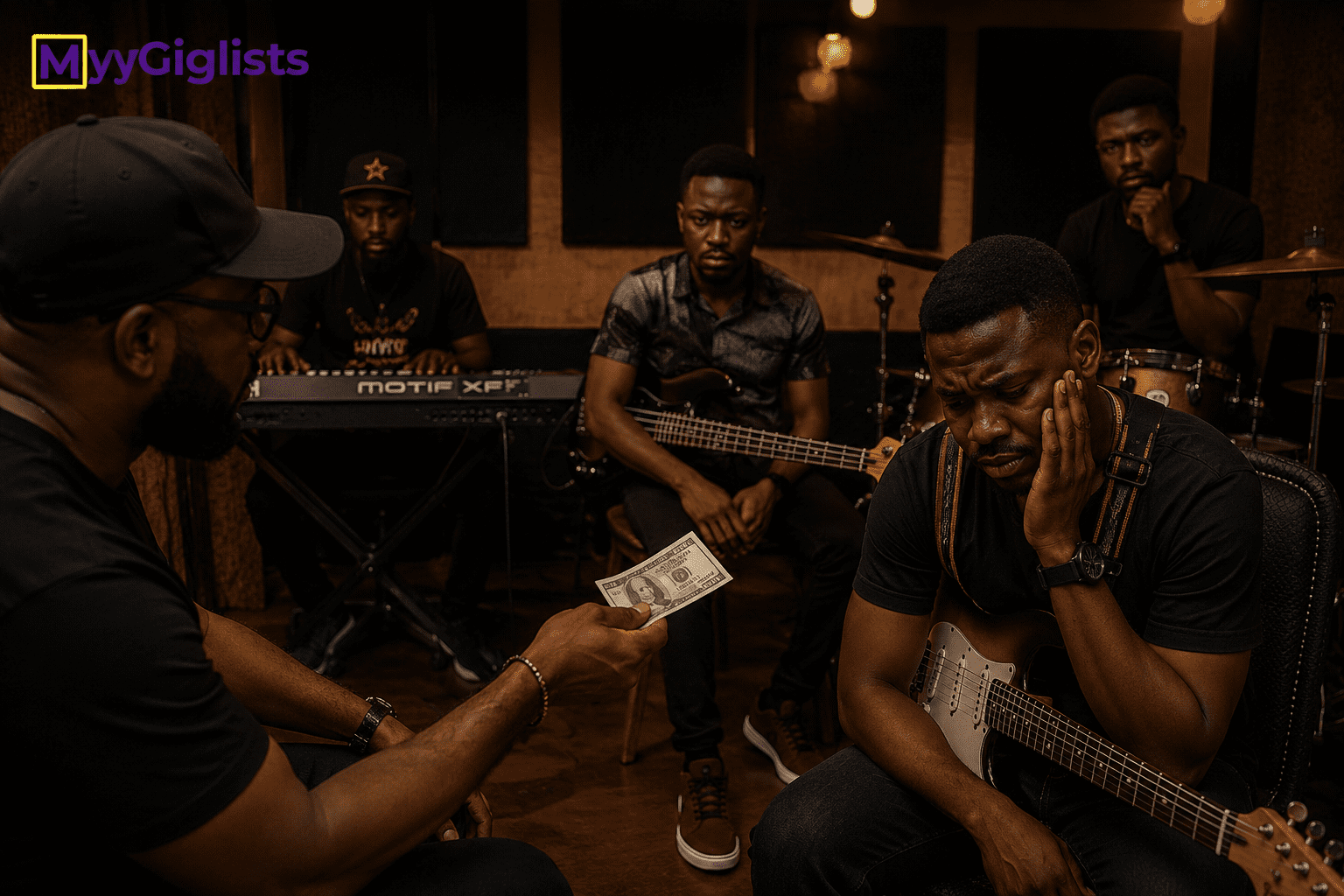
Why Must Nigerian Session Musicians Remain
Underpaid?
A Comprehensive Analysis, Market Insight, and Strategic Roadmap to Fair Valuation
Executive Insight: While Afrobeats commands global dominance, filling arenas worldwide and
generating billions in streams, the specialized human engine driving this sound—Nigeria’s studio and live
session musicians—remains structurally, legally, and financially marginalized. This strategy paper
dissects the root causes of this economic disparity and outlines actionable structural steps to balance
the scales.
1. STATING THE PROBLEM
The global explosion of Afrobeats has established Nigeria as an undisputed cultural superpower. Premium live
shows, international sync placements, and streaming royalties generate unprecedented revenue for top-tier
artists, executive producers, and record labels. However, this wealth fails to trickle down to the foundational
architects of the sound: the session musicians (guitarists, bassists, keyboardists, drummers, horn sections,
and background vocalists).
In the contemporary Nigerian music ecosystem, session musicians are trapped in a low-yield, transaction
based loop. They are overwhelmingly treated as casual day-laborers rather than creative stakeholders. They
are routinely paid flat, substandard day rates that have failed to keep pace with inflation, with zero structural
access to backend royalties, mechanical rights, or performance credits. While a headlining artist may
command between $50,000 to $200,000 per international show, the master instrumentalists who recreate or
build those records on stage or in studios are frequently paid a microscopic fraction, lacking formal contracts,
medical insurance, or residual income safety nets.
2. WHY IT MATTERS
The economic devaluation of session musicians is not merely an ethical oversight; it is an existential threat to
the sustainability of the Nigerian creative economy. It matters because of three core reasons:
Talent Drain and Skills Flight: As living costs in major creative hubs like Lagos climb exponentially, elite
instrumentalists are forced to abandon session work entirely. Many migrate to corporate fields, religious
institutions (where steady monthly stipends exist), or emigrate out of the country (the “Jakpa”
phenomenon), stripping local studios of generational talent.
Erosion of Live Musical Heritage: When master instrumentalists cannot afford to build sustainable
careers, the pipeline for mentoring younger musicians collapses. This leads to an over-reliance on digital
software quantization and loops, threatening the organic, complex rhythms that gave Afrobeats its distinct
global competitive advantage in the first place.
•
•
MyGiglists Industry Insights Report 1
Institutional Disinvestment: International investment firms and institutional catalog buyers look for clean
chain-of-title documentation and formal copyright assignments. The lack of standard contractual structures
among session musicians injects systemic legal vulnerability into Nigerian music assets, depressing overall
catalog valuations.
3. MARKET INSIGHTS & CURRENT REALITIES (2026)
Current data indicates a severe disparity between industry growth and session musician compensation. While
the music industry’s aggregate digital revenue continues to scale, domestic studio day rates for elite
instrumentalists have remained largely flat or have even decreased in real terms when adjusted for inflation
and fuel costs.
Role in
Ecosystem
Standard Compensation
Model
Estimated Share of
Backend Value
Primary Economic Risk
Factor
Lead/Principal
Artist
Advance + Backend
Streaming + Performance
Fees
70% – 90% (Post
Split)
Market relevance & streaming
platform algorithmic volatility
Primary Producer Upfront Production Fee + Up
to 50% of Publishing
25% – 50%
(Publishing)
Infringement risks and
collection inefficiencies
Session Musician
(Studio)
One-off Flat Fee (No Credits
/ No Royalties) 0%
Complete inflation
vulnerability; lack of IP
monetization
Session Musician
(Live Tour)
Per-gig fee / Per-diem (No
long-term contract) 0% Abrupt termination, lack of
health or travel insurance
The structural exclusion is worsened by the digital shifting of music distribution. In mature markets,
neighboring rights societies (such as PPL in the UK or SoundExchange in the US) collect and distribute
royalties directly to non-featured performers (session musicians) whenever a commercial recording is
broadcast or streamed. In Nigeria, the structural framework for neighboring rights collection remains
fundamentally inactive, leaving session musicians entirely dependent on the initial, arbitrary cash handshake.
4. CORE REASONS BEHIND THE UNDERPAYMENT
To solve the problem, we must understand why this paradigm persists. The structural underpayment rests on
four institutional pillars:
A. The Absence of Standardized Neighboring Rights Frameworks
Nigeria’s copyright enforcement has historically prioritized authors, publishers, and labels. The legal and
operational architecture required to track, collect, and distribute royalties for non-featured performers does not
•
MyGiglists Industry Insights Report 2
function at scale. Consequently, even when a song featuring a brilliant live bassline is played millions of times
on global radio or television, the bassist receives exactly zero Naira in residual compensation.
B. Asymmetry of Industry Knowledge
There is a profound systemic lack of intellectual property (IP) literacy among instrumentalists. Many master
musicians view their work purely through the lens of performance prowess rather than asset creation. They
are unfamiliar with split sheets, work-for-hire agreements, neighboring rights registration, or metadata tagging,
leaving them vulnerable to predatory executive practices.
C. Oversupply of Unorganized Labor
Without an active, unified union or guild to set, police, and enforce minimum industry-wide scale rates, session
musicians compete against one another in a race to the bottom. Independent artists and producers easily
exploit this fragmentation by replacing assertive professionals with cheaper, desperate alternatives.
D. Cultural “Work-for-Hire” Misconception
A historical culture of informal patronage persists within the industry. Live band leaders or mainstream studio
owners frequently treat session musicians as apprentices or extensions of their personal brand,
mischaracterizing fairs pay requests as a lack of loyalty or respect for the platform provided.
5. COMMON MISTAKES MADE BY STAKEHOLDERS
Musicians Operating Without Written Contracts: Accepting assignments based entirely on verbal
agreements or “mutual trust.” When the track becomes a global hit, the musician has no legal leverage to
claim performance credits or financial adjustments.
Failing to Insist on Metadata Credit: Allowing tracks to be exported without securing explicit placement
in the digital liner notes (metadata) on DSPs like Apple Music and Spotify. If your name is not in the
metadata, you do not exist to global collection agencies.
Treating the Trade Purely as a Hustle: Neglecting to register as business entities, skipping professional
invoicing, or failing to maintain structured digital portfolios, which prevents corporate brands from engaging
them directly.
Industry Executives Prioritizing Short-Term Cost Cutting: Erroneously believing that underpaying
session talent saves money, whereas it actually generates long-term legal exposure, title disputes, and a
lower-quality sonic product.
6. STEP-BY-STEP SOLUTION & ACTION PLAN
Reversing decades of institutional exploitation requires an aggressive, structured, multi-stakeholder
commercial driving approach. Below is the blueprint for systemic reform:
MyGiglists Industry Insights Report
3
Step 1: Institutionalizing Digital Discovery and Standard Contracting via Technology
The industry must transition away from informal, backroom verbal agreements. Instrumentalists must leverage
professional infrastructure platforms—such as MyGiglists—to formalize their business footprint. By utilizing
structured digital booking platforms, session musicians can mandate standard contract templates, clear
payment milestones, and transparent work-for-hire clauses before a single note is played in the studio or on
stage. This digitizes the paper trail and removes arbitrary verbal negotiations.
Step 2: Universal Implementation of Split Sheets and Metadata Validation
No session musician should exit a recording studio session without executing a formal split sheet or a clear
work-for-hire release document specifying credit terms. Session musicians must demand accurate metadata
inclusion (e.g., Artist, Instrumentalist, Arranger tags) during the audio post-production phase. Platforms and
labels must be held accountable for uploading comprehensive metadata to distributors, ensuring global
tracking engines can identify the participants.
Step 3: Activation and Enforcement of Neighboring Rights Collections
Collective Management Organizations (CMOs) in Nigeria must rapidly deploy operational units dedicated
specifically to tracking and collecting neighboring rights. By collaborating with international bodies, they can
capture the global revenue generated by Nigerian instrumental performance assets, opening a brand-new,
recurring revenue stream for local session musicians.
Step 4: Establish the Nigerian Guild of Professional Instrumentalists
Musicians must self-organize into a disciplined, corporate guild. This body will establish minimum baseline
session day-rates, standard touring per-diems, and mandatory insurance minimums. The guild will issue
compliance certifications to studios and touring artists, effectively blacklisting predatory operations that refuse
to adhere to fair pay scales.
7. CONCLUSION & STRATEGIC ACTION ROADMAP
The status quo is unsustainable. For Nigerian music to maintain its upward international trajectory, the
foundational labor force must be protected, compensated, and incentivized to innovate. The transition from
informal hustle to an structured, highly remunerated professional industry requires rigorous execution across
all tiers.
By enforcing mandatory contracting through verified platforms like MyGiglists, implementing strict metadata
standards, and operationalizing neighboring rights, Nigeria can build a sustainable creative infrastructure
where master session musicians are valued as elite partners in the global Afrobeats success story.